Distinguishing the Original Message of Islam from Extremist Ideology
Clarification
Note: While this analysis addresses the extremist and hateful rhetoric found in Salafi/Wahhabi creeds, it does not apply to followers of traditional, moderate Islam. The author honors those dedicated to Islam’s core values of peace, mercy, and compassion for all.
Abstract
This article examines the contemporary crisis of extremism and “savagery” within the Muslim Ummah, investigating whether such bigotry and violence stem from Islam itself or the specific tenets of Wahhabi/Salafi ideology. I argue that what is often labeled “Islamic” violence is, in fact, an ideological construct born from the deliberate distortion of Islamic doctrine to serve specific sociopolitical agendas.
Through a series of case studies, this paper demonstrates how extremist clergy manipulate Qur’anic verses and classical doctrines to justify their actions. Drawing on the wisdom of the late Grand Mufti of Syria, Sheikh Ahmad Kuftaro, and scholar Hamza Yusuf, I contend that treating this “adulterated thinking” superficially is insufficient; we must uproot the ideological weeds at their source. By exposing the fallacies of radicalism, this article illustrates the path back to authentic Islamic ideals—promoting a future defined by safety, peace, and coexistence.
Observation of a Typical Wahhabi/Salafi Congregational Prayer
Observing congregational prayers and formal addresses can provide insight into the diverse practices and expressions within religious communities. In some settings, discussions may touch upon interpretations of faith that lead to intolerance or exclusion. While mainstream religious leaders often promote interfaith dialogue and community engagement, the views of a minority can sometimes create divisions and misunderstandings.
For decades, this exclusionary style of preaching has become a standardized norm within many Wahhabi communities, gradually rebranding Islam as a faith of negation and denial. This entrenched negativism has defined the movement since its inception in the late 18th century. Indeed, Muhammad ibn Abd al-Wahhab can be described as the ‘architect of negation’; his philosophies of exclusion exceeded those of any figure before or after him. Beyond declaring all who disagreed with him as kuffar (infidels), he codified the ‘Ten Nullifiers of Islam’—an unprecedented set of rules in Islamic history designed to facilitate excommunication and denial.
Examining different interpretations of religious texts and historical contexts, such as the pre-Islamic Arabian concepts of ‘Asabiyyah and Jahiliyyah, can help in understanding the factors that shape various religious perspectives and practices. Understanding these nuances is crucial for fostering dialogue and promoting a more inclusive understanding of faith within diverse societies.
The Supremacy of ’Asabiyyah (Solidarity) in Old Arabia
The concept of ’Asabiyyah, or tribal solidarity, emerged from the ‘Bedouin spirit’ forged in the harsh environment of pre-Islamic Arabia. In a vast desert with scarce resources, survival required an arduous struggle that gave rise to Ghazw—systematic acquisition raids necessary for sustenance. These raids primarily targeted livestock and essential supplies. Consequently, ’asabiyyah became the cornerstone of tribal existence, demanding absolute loyalty: the tribal leader’s word was law, and every member was bound by honor to defend the tribe, regardless of the morality of the cause.
In her book, “Muhammad a Prophet for Our Time,” Karen Armstrong defines ‘asabiyyah and explains how the Prophet overcame such a conflict-causing culture. She explained:
The Supremacy of ’Asabiyyah (solidarity) in Old Arabia. Tribal
solidarity (‘asabiyyah) encouraged bravery and selflessness,
but only within the context of the tribe. There was no concept of
universal human rights. A Bedouin felt responsible merely for his
blood relatives and confederacies. He did not concern outsiders,
whom he regarded as worthless and expendable. If he had to kill them
to benefit his people, he felt no moral anguish and wasted no
time in philosophical abstractions or ethical considerations. Since
the tribe was the most sacred value, he backed it, right or wrong.
What happens when the fierce loyalty of ’asabiyyah is applied to a religious ideology instead of a tribe? It creates a recipe for global disaster. In this system, the clergy take the place of the tribal leader, and the belief system becomes the ‘tribe.’ But there is a deadly difference: tribal ta’assub is restricted to a small group, whereas religious fanaticism has no limits.
This makes religious ta’assub infinitely more dangerous. It oversteps all legitimate boundaries, blinding its followers and sealing their hearts. In this state of mind, even the clear guidance of the Qur’an and the true sunnah of the Prophet ﷺ are ignored in favor of blind sectarian loyalty.
Jahiliyah –Jahiliyyah: The Ethos of Pre-Islamic Tribalism
The second essential term to examine is Jahiliyyah. In Islamic theology, this term traditionally denotes the socially antagonistic culture of pre-Islamic Arabia. Karen Armstrong, in her work Muhammad: A Prophet for Our Time, provides a critical nuance to its definition:
“The leading voice of the Kafirun [disbelievers] was jahiliyyah… Although the root J-H-L carries connotations of ‘ignorance,’ its primary meaning is ‘irascibility’: an acute sensitivity to honor and prestige, arrogance, excess, and, above all, a chronic tendency toward violence and retaliation. Jahili people were too proud to surrender to Islam… The Muslims called Abu l-Hakam [‘the Wise One’], their chief enemy, ‘Abu Jahl’ [‘the Jahil One’], not because he was ignorant of Islam—he understood it too well—but because he fought Islam arrogantly, with blind, fierce, and reckless passion.”
Prophet Muhammad ﷺ sought to transform Muslims into rational, serene, and tranquil individuals who would never fall prey to the “vengeful fury of jahiliyyah.” He frequently took drastic measures to prevent jahili outbursts, even among his own followers. For instance, during an expedition, a quarrel broke out between two boys—one from the Ansar and one from the Muhajireen—over access to a water source. Immediately, the cry of ’asabiyyah erupted as both called for their respective groups to intervene.
Exploiting this tension, the leader of the hypocrites, Ibn Abi Salul, fueled the fire with provocative language intended to undermine the Prophet ﷺ. Upon hearing of the vendetta, the Prophet immediately ordered the expedition to march toward Medina without rest, allowing the physical exertion to cool their anger and leaving no room for the fury to ignite. He admonished the Muslims to cast off these ancient prejudices, famously declaring: “Why do you raise the cry of Jahiliyyah? Abandon it; for it is rotten” (Bukhari).
For generations, ’asabiyyah and jahiliyyah fueled perpetual wars and blood feuds among the Bedouin tribes. Today, one must ask: are the reckless, destructive, and brutal acts of ISIS and other extremists since the inception of Wahhabism anything less than a modern reproduction of this ancient, “rotten” culture?
To appreciate the nuances of any faith, it is helpful to explore its foundational principles and values as understood and practiced by the majority of its adherents. Many Muslims are guided by the concept of Samahatul-Islam, which emphasizes moderation, simplicity, and ethical conduct. This perspective highlights compassion, human dignity, and charitable service as central to the faith.
A core tenet within this understanding is the sanctity of human life and the recognition of shared humanity. Islamic teachings often stress the importance of kindness towards family, neighbors, and the wider community. There is an emphasis on individual responsibility and the pursuit of positive relationships with others.
Examining key texts and teachings can provide further insight into these principles and how they have shaped the beliefs and practices of Muslims throughout history.
A Specialized Relationship: The People of the Book:
Islam maintains a unique and honored relationship with the “People of the Book” (Jews and Christians), acknowledging the divine origins of the scriptures they received. The following verses underscore this bond of mutual respect and shared faith:
Unity of Prophethood:
“Say, [O believers], we have believed in Allah and what has been revealed to us… and what was given to Moses and Jesus and what was given to the prophets from their Lord. We make no distinction between any of them, and we are Muslims [in submission] to Him.”— Qur’an 2:136
Justice and Compassion toward Others:
“Allah does not forbid you from those who do not fight you because of religion and do not expel you from your homes—from being righteous and acting justly toward them. Indeed, Allah loves those who act justly.” — Qur’an 60:8
Recognizing Shared Faith and Reward:
“And indeed, among the People of the Book are those who believe in Allah and what was revealed to you and what was revealed to them, [being] humbly submissive to Allah… Those will have their reward with their Lord.”— Qur’an 3:199
The Invitation to Common Ground:
“Say, ‘O People of the Scripture, come to a word that is equitable between you and us—that we will not worship except Allah and not associate anything with Him…’”— Qur’an 3:64
The Ethics of Dialogue:
“And do not argue with the People of the Book except in a way that is best, unless it is with those who inflict wrong and injury, and say, ‘We believe in that which has been revealed to us and revealed to you. Our God and your God is one, and we are Muslims [in submission] to Him.’”— Qur’an 29:46
The Principle of Non-Compulsion and Spiritual Autonomy
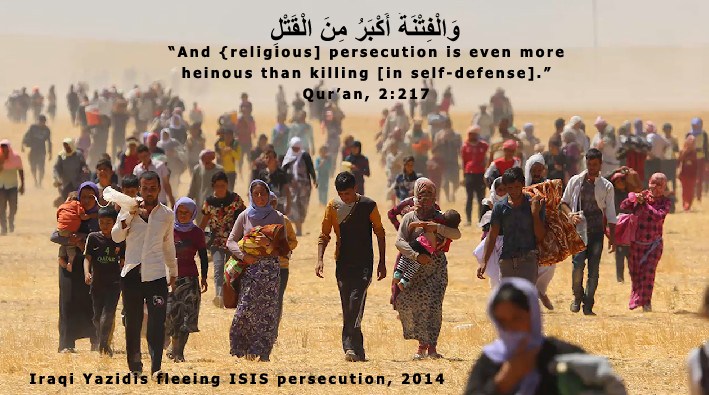
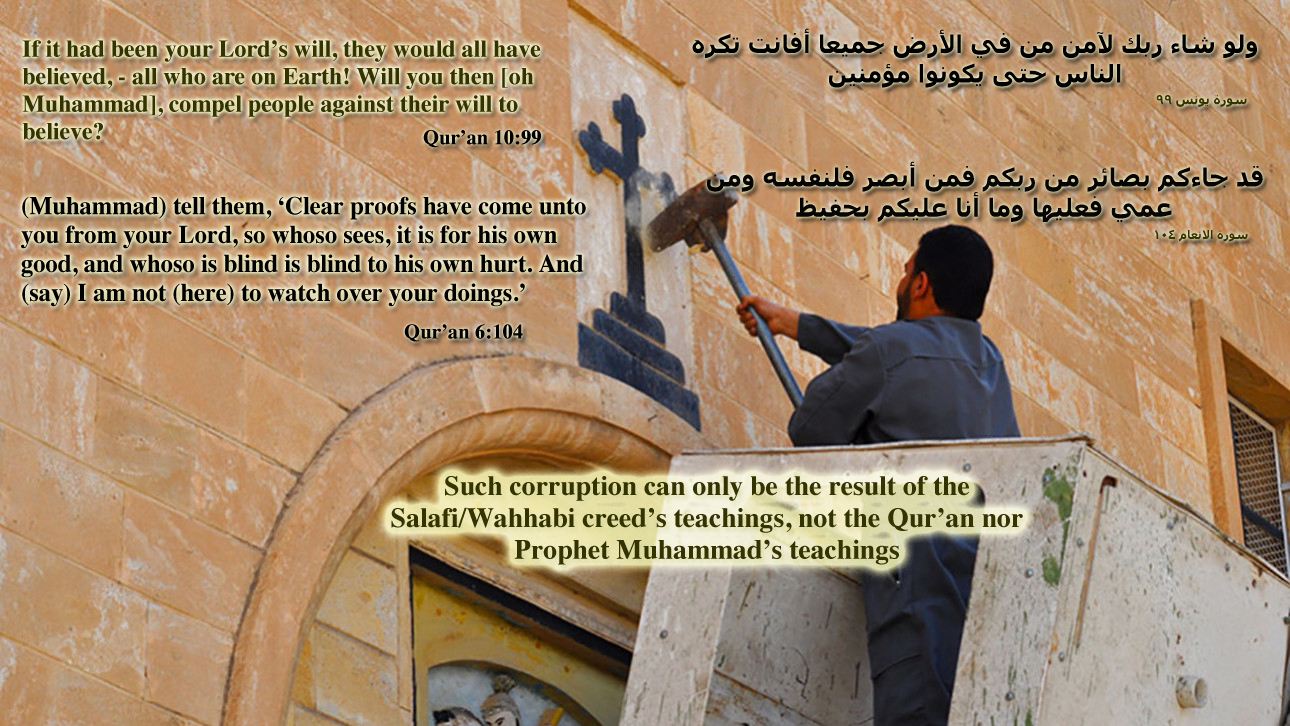
The indiscriminate violence of ISIS—including the destruction of property, the violation of human rights, and the persecution of individuals for their beliefs—stands in total opposition to the foundational teachings of Islam. While these actions may align with the narrow instructions of extremist creeds, the noble and graceful principles of authentic Islam regarding freedom of conscience are unequivocal.
A. The Prohibition of Compulsion
Islam establishes that faith must be a product of whole-hearted conviction, not external pressure. A forced belief is spiritually void. The Qur’an articulates this principle with absolute clarity:
“There shall be no compulsion in [acceptance of] the religion. The correct course has become distinct from the wrong…” — Qur’an 2:256
B. The Rejection of Religious Policing
The Qur’an explicitly instructs Prophet Muhammad ﷺ that his role is that of a messenger, not a religious authority sent to monitor or enforce the practice of others. He was sent to deliver the message, not to act as a moral policeman. This is affirmed by several verses:
“But We made you not one to watch over their doings, nor are you set over them to dispose of their affairs.” — Qur’an 6:107
“But if they turn away, then your duty [O Prophet] is only to deliver the message.” — Qur’an 16:82
“We have not sent you [O Muhammad] to be their keeper, governing their activities.” — Qur’an 4:80
In his Grand Tafsir, the renowned scholar Al-Fakhr al-Razi comments on verse 4:80, stating that Allah explicitly instructs the Prophet not to coerce but to preach. If the Prophet himself was not authorized to police the beliefs of others, by what authority do groups like ISIS justify their coercion? Their actions reflect a deviation into extremist creeds rather than an adherence to the Prophetic model.
C. The Divine Gift of Free Will
The Qur’an outlines that the diversity of belief is permitted by Divine Will, granting human beings the faculty of choice,
“And had your Lord willed, those on earth would have believed—all of them entirely. Then, [O Muhammad], would you compel the people so that they become believers?” — Qur’an 10:99
The arrival of the final message was not intended as a source of hardship or terror, but as a healing and mercy for all of creation:
“And We have not sent you, [O Muhammad], except as a mercy to the worlds.”— Qur’an 21:107
“O humankind, there has come to you instruction from your Lord, a healing for what is in the hearts, and guidance and mercy for the believers.”— Qur’an 10:57
The Ethos of Divine Mercy and the Sanctity of Life
The character of Prophet Muhammad ﷺ was the living embodiment of compassion. As explored in the article “The Five Nobilities of Islam”, his entire life reflected a nature of profound mercy—even in the heat of conflict. Unlike the scorched-earth tactics of modern extremists, the Prophet established a strict code of Qur’anic Ethics in Warfare: he forbade the killing of non-combatants, including women, children, and the elderly, and prohibited the destruction of trees, crops, and places of worship.
E. Divine Justice: Rewards for the Righteous
The Qur’an affirms that God’s justice and mercy are not confined by narrow sectarian labels, but are extended to all who possess faith and perform righteous deeds:
“Indeed, those who believed and those who were Jews, Christians, or Sabeans—those who believed in Allah and the Last Day and did righteousness—will have their reward with their Lord, and no fear will there be concerning them, nor will they grieve.” — Qur’an 2:62
F. The Sanctity of the Human Soul
In Islamic theology, the soul is a Divine trust. To protect this endowment, Allah established the most stringent safeguards for its preservation:
“…Whoever kills a soul unless for a soul or for corruption [done] in the land—it is as if he had slain mankind entirely. And whoever saves one—it is as if he had saved mankind entirely…”— Qur’an 5:32
This verse elevates the protection of a single life to a universal level. This mandate of “saving life” is not limited to war or catastrophe; it encompasses the very foundation of civilization—from medicine and public safety to environmental protection and industrial ethics.
Conclusion: Samahatul-Islam vs. The Ideology of Destruction
When the principles of Samahatul-Islam—with its emphasis on ease, grace, and universal mercy—are held up as a mirror to the actions of groups like ISIS, the contrast is absolute. The evidence from the Qur’an and the Prophetic tradition leaves no room for ambiguity: the path of the Prophet ﷺ was one of building life, protecting the vulnerable, and sanctifying the soul.
The brutal reality is that extremism is not a “stricter” version of Islam, but a total departure from it. It is the bitter harvest of a specific sectarian creed that has traded the vastness of Divine mercy for the narrowness of political hatred. This raises a defining question for the modern era: What specific catalysts allowed this “culture of negation” to take root, and how can we uproot it to restore the authentic, peaceful heart of the faith?
Cultivating Bigotry: The Distortion of Scriptural Meaning
Having established the framework of Samahatul-Islam, I must share a recurring experience from my time attending congregational prayers—one that illustrates how the message of the Qur’an is often weaponized to foster division.
In one such instance, a young Imam—donning a robe and head covering (see: Is Men’s Traditional Dress Truly a Prophetic Sunnah?)—began his sermon by warning the congregation of the “dangers” posed by their neighbors. He characterized the surrounding Christian and Jewish communities as people who associate partners with Allah, and described the streets as overflowing with vice, music, and moral decay. His central claim was that no deed performed by these individuals—regardless of how charitable or noble—would ever be accepted by God. To justify this exclusionary stance, he cited the following verse:
“And whoever desires other than Islam (submission) as religion – never will it be accepted from him, and he, in the Hereafter, will be among the losers.” — Qur’an 3:85
The Theological Twist
While the Imam based his “theory of rejection” on this verse, he performed a subtle but dangerous linguistic twist. He transformed a Divine standard for religious acceptance into a tool for instilling hatred toward the “Other.”
This raises critical questions: Why should a criterion set by God be used as fuel for bigotry? Has the Imam forgotten that even a Muslim’s deeds are not unconditionally accepted? In Islam, the acceptance of any act is contingent upon humility, sincerity, and the absence of vanity or “showing off” (Riya). If a Muslim lacks these qualities, their deeds are also at risk of rejection. Why then is this verse used to grant Muslims a “blanket of acceptance” while condemning all others?
A Scholarly Correction
The misrepresentation of verse 3:85 is a common pitfall. In his translation for Oxford University Press, M.A.S. Abdel Haleem provides a vital clarification:
“It has to be borne in mind that the word ‘islam’ in the Arabic of the Qur’an means complete devotion and submission to God… The Qur’an thus describes all earlier prophets as ‘muslim.’ Those who read the word ‘islam’ [in this verse] solely as the specific religion of Prophet Muhammad will set up an illegitimate barrier between Islam and other monotheistic faiths.”
By narrowing the universal meaning of Islam (submission to God) into a narrow sectarian label, extremist rhetoric “hijacks” the text, turning a call to Divine devotion into a wall of exclusion.
The “Enemies of Woman” and the Institutionalization of Bigotry
During a visit to a mosque near Denver, Colorado, my attention was drawn to a booklet titled “The Enemies of Woman.” A brief browsing revealed a staggering claim: the primary “enemies” of women are Christians, Jews, and Western modernism. The author argued that Western culture’s supposed lack of sexual boundaries and its exploitation of women fueled this hostility.
This raises a vital question: why is a universal human struggle—the regulation of modesty and ethics—weaponized as a tool for sectarian bigotry? The booklet served as little more than a hate tactic, implying that Muslims are somehow immune to the very moral failings it condemned in others.
Most troubling was the author’s identity. He was not a fringe extremist or an uneducated zealot; he was Abd al-Aziz ibn Baz, the late Grand Mufti of Saudi Arabia and an icon of modern Salafi/Wahhabi learning. Despite his status, Ibn Baz displayed a profound ignorance of the countless Christians, Jews, and Westerners who actively oppose immodesty and sexual exploitation. Instead of offering a constructive Islamic treatment for social ills, the highest spiritual authority of the Saudi state chose to use the sensitive topic of gender and morality to fuel xenophobia.
The Systematic Distortion of the Word Awliya
In June 2011, while in Jeddah, Saudi Arabia, I discussed the massive state project in Medina dedicated to the translation and global distribution of the Holy Qur’an. My hosts emphasized that hundreds of scholars oversaw this project to ensure “accuracy and authenticity.”
However, upon examining the English translation of the King Fahd Complex, I was shocked to find that a significant interpretive error—originally popularized by Yusuf Ali in 1934—was not only preserved but also institutionalized. While Yusuf Ali may have struggled with Arabic nuances, the Saudi decision to maintain this error is a deliberate Wahhabi/Salafi twist designed to foster animosity toward Christians and Jews.
Verse 5:51: Friends or Military Allies?
The distortion centers on the word Awliya. In the context of 7th-century Arabia and now, Awliya referred to military allies solicited for victory in war. Yet, the King Fahd translation renders it as follows:
“O you who have believed! Take not the Jews and the Christians for your friends and protectors: They are the friends and protectors of each other. And he amongst you that turns to them (for friendship) is of them…” — Qur’an 5:51
By translating Awliya as “friends,” the Salafi clergy effectively forbids Muslims from forming basic human bonds, neighbors, or friendships with non-Muslims. This is a radical departure from the Qur’anic meaning, which addressed specific military alliances during times of conflict. By weaponizing this mistranslation, the state-sponsored “Ifta” (verdicts) departments have turned a verse about wartime strategy into a permanent mandate for social isolation and bigotry.
Mainstream Scholarly Consensus on Awliya
To understand the gravity of the King Fahd Complex’s mistranslation, we must consult the masters of classical exegesis (Tafsir). Dr. Wahbah al-Zuhayli, in his renowned work Al-Tafsir al-Munir (The Enlightened Interpretation), provides the necessary historical context. He clarifies that the word Awliya in Verse 5:51 refers specifically to military allies sought for victory during conflict.
Citing a chain of classical authorities—including Ibn Ishaq, Ibn Jarir al-Tabari, and Al-Bayhaqi—Dr. Zuhayli explains that this verse was revealed in response to a specific breach of covenant. When the Jewish tribe of Banu Qaynuqa’ violated their treaty with the Muslims, the companion Ubadah ibn al-Samit formally dissolved his military pact (hilf) with them. Thus, the verse was a directive regarding strategic wartime alliances, not a ban on social interaction.
Defining Terms: Allies vs. Friends
The distinction between an “ally” and a “friend” is both linguistic and political:
– Al-Fakhr al-Razi, in his Mafatih al-Ghayb (The Great Exegesis), defines Awliya as supporters belonging to a specific political or military camp.
– Ibn Kathir, arguably the most-cited authority in the Salafi tradition, also defines the term as “allies.”
– Modern Context: Alliances are often born of necessity rather than affection. Economic ventures, geographical interests, or petroleum partnerships are “alliances,” yet the parties involved may not be “friends” in a personal or spiritual sense.
Linguistic Evidence: Sadeeq vs. Mawadda
The Qur’an is precise in its vocabulary. If God intended to forbid “friendship,” the Arabic language offers specific terms that were bypassed in Verse 5:51:
1. Sadeeq (Friend): This is the standard Arabic word for “friend.” It appears in the Qur’an in various contexts—such as the “close friend” missing in the Hereafter or the permission to eat at a “friend’s house” (24:61). Significantly, neither Sadeeq nor its derivatives appear in the verses regarding Awliya.
2. Mawadda (Affection/Love): When the Qur’an speaks of deep, warm relationships, it uses terms like Yuwaddoona. For example, Verse 58:22 mentions those who “love” (Hhad) those who contend against God. The word Hhad implies active warfare and hostility. Even here, the prohibition is against loving those in an active state of war against the faith, not against non-Muslims in general.
The Institutionalization of an Error
The King Fahd Holy Qur’an Printing Complex—the same institution that distributes millions of copies worldwide—has repeated this mistranslation in Surah 60:1 and Surah 5:57, by rendering Awliya as “friends,” inducing a “negation” that contradicts the inclusive, healing guidance of the Qur’an. In contrast, the Sahih International translation provides a more accurate rendering:
“O you who have believed! Take not the Jews and the Christians as allies. They are [in fact] allies of one another…” — Qur’an 5:51
Those who insist on translating Awliya as “friends” do a profound injustice to the spirit of Islam. By turning a strategic wartime directive into a social barrier, they ignore the universal essence of a faith that promotes kindness, justice, and friendship for all humanity.
Institutionalized Prejudice: The Parenthetical Distortions of Al-Fatiha
Evidence of this systemic bigotry extends into the foundational education of the Saudi state. A Saudi friend once shared his childhood experiences with me, noting: “In school, we were explicitly taught not to take Christians and Jews as friends.” This indoctrination is not merely verbal; it is codified in the very translations distributed to students and the global public.
One of the most glaring examples is found in the “Noble Qur’an,” the English translation by Mohsin Khan and Muhammad Al-Hilali, sanctioned by the Saudi state. In the opening chapter, Al-Fatiha—the most recited passage in Islam—the translation of Verse 7 is modified as follows:
“The path of those upon whom You have bestowed favor, not the way of those who earned Your anger (such as the Jews), nor of those who went astray (such as the Christians).” — Qur’an 1:7
The Insertion of Hatred into Prayer
The clauses “such as the Jews” and “such as the Christians” are presented as if they are integral parts of the Divine text. By inserting these specific groups into parentheses, the Salafi/Wahhabi interpretation transforms a universal spiritual warning into a targeted racial and religious slur.
The original Arabic—al-maghdoobi ‘alayhim (those who earned anger) and ad-dhalleen (those who went astray)—describes a state of being or a moral failure that can apply to any human being, including Muslims. One can “earn anger” through arrogance or “go astray” through negligence, regardless of their religious label. By singling out Jews and Christians, this interpretation creates a “theology of exclusion” that ignores the Qur’anic warnings against those within the Ummah who earn God’s curse through hypocrisy or injustice.
Prayer as a Training Ground?
The gravity of this distortion cannot be overstated. A practicing Muslim recites Al-Fatiha at least 17 times a day during the five obligatory prayers. Prayer is intended to be a sanctuary for the soul—a time for humility, tranquility, and a profound connection to the Divine. It is meant to soften the heart and broaden one’s compassion for all of creation. However, when a believer is conditioned to associate “God’s wrath” and “error” specifically with their Christian and Jewish neighbors every few hours, prayer is weaponized. It ceases to be a spiritual exercise and becomes a training ground for intolerance, prejudice, and persistent negativity.
The Doctrine of Al-Wala’ wal-Bara’: Loyalty, Enmity, and the Fallacy of Generalization
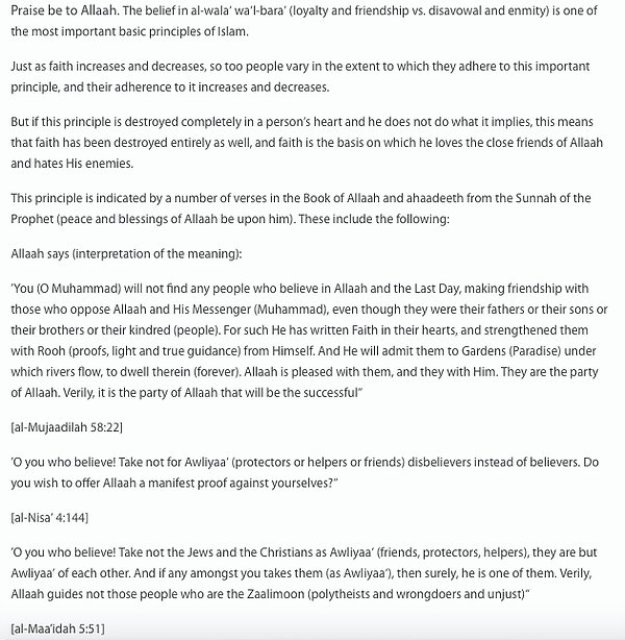
The Salafi/Wahhabi doctrine of Al-Wala’ wal-Bara’ (Loyalty and Disavowal) is often presented by its adherents as “the most fundamental principle of Islam.” However, a critical analysis reveals that this doctrine rests on a systematic distortion of scripture—specifically, the generalization of verses intended for the battlefield into universal social mandates.
The Error of Universalizing Wartime Directives
The fundamental flaw in the Wahhabi application of Al-Bara’ (Enmity/Disavowal) is the “Generalization Fault.” It takes a specific Quranic stance intended for those who actively aid an adversary during war and applies it to all non-Muslims globally. This occurs despite the fact that the vast majority of people—regardless of faith—are not engaged in any hostility toward Islam or Muslims.
As Dr. Adnan Ibrahimclarifies, Al-Bara’ (the mandate to distance oneself or express aversion) applies strictly to those committing active aggression. It is not a blanket permit for hatred toward humanity.
The Quranic Counter-Mandate: Justice and Equity
The “Enmity” portion of this doctrine directly violates the compassionate spirit of Islam. Allah explicitly commands Muslims to maintain fairness and kindness toward those who do not engage in religious persecution:
“Allah does not forbid you from those who do not fight you because of religion and do not expel you from your homes—from being righteous and acting justly toward them. Indeed, Allah loves those who act justly.”— Qur’an 60:8
Coexistence (Ta’aruf) vs. Alienation
The mandate for “disavowal and enmity” against most of the world’s nations conflicts with the Divine wisdom of creation. As discussed in the Samahatul-Islam section, Allah established the standard of Ta’aruf—a framework for peaceful, cooperative coexistence:
“O humankind, indeed, We have created you from male and female and made you nations and tribes (lita’arafu), so you may learn about one another… Indeed, the noblest of you in the sight of Allah is the most righteous of you.”— Qur’an 49:13
In the sight of the Creator, nobility is achieved through the integrity of one’s interaction with others, not through the depth of one’s “hate and defiance.”
Virtue in Every Interaction
Furthermore, the Qur’an promotes universal harmony through the simple act of greeting. Muslims are directed to respond to any salutation with even greater kindness, fostering virtue rather than negativity:
“When you are greeted with a salutation, greet with one kinder than it, or at least return it. Indeed, Allah keeps account of all things.” — Qur’an 4:86
To transform a faith that commands a “kinder greeting” into a doctrine of “chronic enmity” is to reject the very civility and mercy that the Qur’an came to establish.
The Context of “Disavowal”: War, Espionage, and Active Hostility
The Holy Qur’an contains verses that command Muslims to disassociate from certain individuals—whether Muslim or otherwise—based on their specific evil acts. These commands are not rooted in religious bigotry, but rather in a response to active hostility against Allah, the Prophet ﷺ, and the safety of the Muslim community.
1. Defining Hostility (Hhad)
A key verse used by extremists to justify isolation is often misinterpreted by ignoring the specific Arabic terminology:
“You will not find a people who believe in Allah and the Last Day having affection for those who oppose (Hhad) Allah and His Messenger, even if they were their fathers or their sons or their brothers or their kindred…” — Qur’an 58:22
The Arabic term Hhad is the operative word here. It does not refer to someone who simply holds a different faith; it signifies those who are in a state of active warfare, challenging the believers with violence, or committing adverse actions intended to destroy the community. The disavowal mentioned here is a rejection of the individual’s actions and hostility, even if they are close kin.
2. Security and Alliances during Conflict
Similarly, other verses focus on specific security conditions, such as spying, assassination, or providing military assistance to an enemy force against the believers:
“Let not believers take disbelievers as allies (Awliya) rather than believers. And whoever [of you] does that has nothing with Allah, except when you take a precaution against them in prudence. And Allah warns you of Himself, and to Allah is the [final] destination.”— Qur’an 3:28
This verse serves as a security protocol during times of active peril. It warns against forming alliances with those who seek to harm the community from within. The “disavowal” here is a protective measure for the survival of the state and the faith, not a mandate for perpetual social enmity against peaceful neighbors.
The Prophetic Model: Compassion and Diplomacy with Non-Believers
The historical record of Prophet Muhammad ﷺ and his companions is filled with examples of profound affection and strategic cooperation with non-believers. These interactions provide a sharp contrast to the extremist doctrine of universal enmity, proving that Islam differentiates between individuals based on their character and actions, not merely their religious label.
1. The Bond of Kinship and Support: Abu Talib
Prophet Muhammad ﷺ held deep admiration and love for his uncle, Abu Talib, despite the latter remaining outside the fold of Islam. Historians labeled the year of his death the “Year of Sorrow” (‘Am al-Huzn), marking the Prophet’s intense grief over the loss of both his uncle and his beloved wife, Khadijah. Abu Talib was a pillar of support who shielded the Prophet from persecution. Reflecting on this bond, the Prophet ﷺ remarked:
“Quraysh did not hurt me so severely while Abu Talib was alive.”— Ibn Hisham
2. Loyalty Beyond Faith: Al-Mut’im bin Adi
Another notable figure was Al-Mut’im bin Adi, an idolater for whom the Prophet ﷺ held a lasting debt of gratitude. Al-Mut’im had provided the Prophet protection during a crisis in Mecca and helped end the brutal 28-month siege against the Prophet’s clan. After the Battle of Badr, the Prophet ﷺ stated:
“If Al-Mut’im bin Adi were alive and interceded with me for these [filthy] prisoners of war, I would have released them for his sake.”— Sahih Bukhari
When Al-Mut’im passed away, the Muslims mourned him, and the Prophet’s poet, Hassan ibn Thabit, composed verses in his honor—demonstrating that Muslims were encouraged to recognize and celebrate the virtue of non-Muslims.
3. Strategic Trust: The Tribe of Khuza’ah
The Prophet ﷺ did not isolate himself from non-believing communities; rather, he engaged in sophisticated diplomacy. He consulted the non-Muslim tribe of Khuza’ah, listened to their counsel, and entrusted them with secrets regarding the Quraysh. Their relationship was built on mutual trust and shared interests, not religious exclusion.
4. Reasoning Over Radicalism: The Case of Hatib ibn Abi Balta’ah
Perhaps the most striking evidence against “blanket enmity” is the incident involving Hatib ibn Abi Balta’ah. Before the conquest of Mecca, Hatib attempted to leak the Prophet’s secret military plans to the Quraysh. When confronted, Hatib explained that his actions were motivated by a desperate desire to protect his family in Mecca, not by affection for the idolaters’ faith or a desire to betray Islam.
Rather than executing him for treason or applying a rigid “disavowal,” the Prophet ﷺ accepted his explanation and showed mercy. This incident demonstrates that Islam addresses sensitive matters with reason, fairness, and psychological insight, rather than the blind fanaticism seen in extremist creeds.
The Danger of Ghulu (غُلُوّ) (Excessiveness)
To oversimplify the relationship between Muslims and non-Muslims as one of perpetual hostility is an offense against Allah, the Qur’an, and the Prophetic tradition. The Qur’an identifies this type of extremism as Ghulu—religious excessiveness.
One must ask: Why has an irrational aversion toward peaceful people been promoted as “one of the most important principles of Islam”? The answer lies in the return of ‘Arrogance and asabiyyah (tribal fanaticism) within the creed. When a particular clergy’s verdict is placed above the Divine way of God, ‘asabiyyah blinds the sight, veils the heart, and locks the mind, transforming a faith of mercy into a tool of exclusion.
In Islamic theology, Ghulu (غُلُوّ) refers to excessiveness, extremism, or going beyond the prescribed limits in religious matters. It is generally discouraged in the Quran and Sunnah (Prophetic tradition).
Several Quranic verses warn against Ghulu:
Qur’an 4:171:
“O People of the Scripture, do not exceed the limits in your religion or say about Allah except the truth…”
Qur’an 5:77:
“Say, ‘O People of the Scripture, do not exceed the limits in your religion beyond the truth and do not follow the inclinations of a people who have erred before and misled many and have strayed from the sound way.'”
The concept of Ghulu encompasses various forms of excess, including:
1- Exaggerated beliefs about religious figures: Attributing divine qualities to prophets or saints beyond their human status.
2- Imposing unnecessary hardships in religious practice: Going to extremes in acts of worship that were not intended to be difficult.
3- Strict and inflexible interpretations of religious texts: Rejecting diverse understandings and insisting on a single, rigid approach.
4- Excessive condemnation of others: Harshly judging or excommunicating fellow Muslims for minor differences in opinion or practice.
The Prophet Muhammad (peace be upon him) also warned against Ghulu, as narrated in several Hadith. For example, he is reported to have said, “Beware of Ghulu (extremism) in religion, for verily, those who were before you were destroyed because of Ghulu in religion.” (Ahmad, Nasa’i, and Ibn Majah)
The emphasis in Islamic teachings is often on moderation and finding a middle path, avoiding both negligence and excess. This approach is sometimes referred to as wasatiyyah (وسطية), meaning moderation or the middle way.
Regarding clothing styles, Islamic teachings emphasize modesty for both men and women. However, specific styles of dress, like the Thawb or particular head coverings, are often influenced by cultural and regional factors rather than being universally mandated religious requirements.
The Prophet did not wear special clothing; he merely followed the traditional attire of the people. Following his example, the Sunnah, one can adapt to different times, places, and cultural contexts, provided that the core Islamic principles of modesty are upheld.
The Theology of Inclusion
The theology of inclusion presented in the verse (Qur’an 2:136) differs dramatically from the sectarian doctrine of Al-Wala’ wal-Bara’ (Loyalty and Disavowal), particularly as practiced by extremist groups.
The core difference lies in context: inclusion is a universal ethical mandate, whereas the extremist interpretation of disavowal misapplies specific wartime security directives.
Theology of Inclusion: The Moderate View
The inclusive message emphasizes shared humanity and a common spiritual origin for all Abrahamic faiths. It is based on several core principles:
Principle
Description
Source
Universal Revelation
The belief that all prophets, from Abraham to Muhammad, brought the same
essential message of monotheism. Distinctions between them are rejected.
Qur’an 2:136
Justice & Kindness
The mandate to treat peaceful non-Muslims with qist (justice) and birr (kindness/righteousness) is a primary ethical obligation.
Qur’an 60:8
Ta’aruf
The goal of human diversity (tribes and nations) is mutual learning,
collaboration, and building a peaceful society, not alienation.
Qur’an 49:13
Freedom of Conscience
Faith must be a sincere choice, not something coerced by force.
Qur’an 2:256
The Doctrine of Al-Wala’ wal-Bara’: The Extremist View
Extremist and Salafi-Jihadi interpretations of Al-Wala’ wal-Bara’ distort this message by taking verses meant for specific battlefield scenarios and universalizing them into a permanent state of social enmity.
Principle
Description
Extremist Distortion
Loyalty (Wala’)
Loyalty to God and fellow believers.
Requires an explicit hatred for all non-Muslims; lack of this hatred is a sin or apostasy.
Disavowal (Bara’)
Disassociating from active aggressors or evil acts.
Becomes a blanket “disavowal of anything deemed un-Islamic,” requiring social isolation, avoidance of holidays, and refusal of basic friendship with all non-Muslims.
Contextual Error
Verses about military alliances during active war (Awliya as “allies”).
Mistranslated as “friends” to forbid basic human friendship with Christians/Jews at all times, regardless of peaceful coexistence.
Al-Wala’ wal-Bara’ Summary
The theology of inclusion is a moral imperative for universal peace, whereas the extremist application of Al-Wala’ wal-Bara” is a political fabrication that reduces a rich faith to a narrow “theology of power” and exclusion.
Possible Results of distortion Section here
The Intent of Ritual vs. The Formation of Form
In Islam, the ultimate goal of a ritual is primary, whereas its physical form is often secondary. To use an analogy: the purpose of a vehicle is to transport its passengers safely from one point to another; its color or body style is a secondary matter of preference. In the same way, the object of piety is an action that seeks Allah’s pleasure by avoiding sin, embodying the beauty of faith, and—crucially—ensuring that no harm is caused to others during its realization.
Only after the heart is aligned does the ritual’s form follow. This hierarchy of values is illustrated in a profound exchange from the Prophetic tradition. A man came to the Prophet ﷺ during the Hajj and expressed concern about the order of his rituals, saying he had performed the Sa’ie (running between Safa and Marwa) before the Tawaf (circumambulating the Ka’ba). The Prophet ﷺ replied:
“No issue [there is no harm]. The only real issue is when one infringes upon the honor of his brother.” — Sunan Abi Dawood
The Core vs. The Digressive
Understanding Islam’s core functions—mercy, justice, and the protection of human dignity—while paying less attention to digressive or minor formalistic issues could resolve many of the conflicts and setbacks facing the Muslim world today.
When a person infringes on the honor of a brother or friend—through defamation, luring, or betrayal—the damage to the social fabric is significant and often irreversible. We must be discerning enough to know where the real “sin” lies. The Prophet ﷺ emphasized that “no issue” arises from the technical order of rituals, yet great peril lies in the mistreatment of others. This sense of spiritual prudence—the ability to distinguish between a technicality and a moral catastrophe—is what is desperately missing in modern religious discourse.
The Salafi/Wahhabi System: A Paradigm of Restriction and Denial
When the meticulous observation of ritualistic forms becomes the sole objective of faith—and when the permissible is systematically rebranded as prohibited—human existence is reduced to a rigid architecture of restraints. Such a system, rooted in negation, stands in direct opposition to the expansive spirit and ethical objectives of the Qur’an.
In his seminal work, The Great Theft: Wrestling Islam from the Extremists, Dr. Khaled Abou El Fadl characterizes Salafi/Wahhabi fanatics as “Puritans” due to the “absolutist and uncompromising nature” of their belief system. He argues that for the Puritan, technical specifics take precedence over the Qur’an’s moral objectives. In contrast, for the “Moderate”—representing the historical mainstream of Islamic thought—moral and ethical purposes serve as the pivotal axis of legal analysis. For the Moderate, the goal of legal research is not the unthinking implementation of technical rules, but the pursuit of the Qur’an’s ultimate objectives: justice (‘adl), equality, and freedom of conscience.
The Mechanization of the Human Soul
Dr. Abou El Fadl observes that, because Puritans regard specific rules as ends in themselves rather than as illustrative examples, they enforce them regardless of whether the outcome undermines justice or mercy. He elaborates:
“Puritans force upon Muslims a kind of austerity that is entirely suffocating. Much of what they advocate is affirmatively designed to remove tenderness and kindness from the human heart. They eradicate art, beauty, and anything else that excites the creative imagination, demanding that Muslims become mechanized robots.”
This “mechanization” manifests in an exhaustive list of prohibitions that regulate every minute aspect of life—from how one sits to how one celebrates. Below are examples of common Puritan restrictions observed in various extremist enclaves today:
Area of Life
Puritan Prohibition / Restriction
Arts & Expression
All forms of music, singing, dancing, and acting are forbidden.
Media & Culture
Non-religious television and the drawing of living
figures are prohibited.
Social Etiquette
Clapping, standing in honor of others, or
Giving flowers is forbidden.
Personal Grooming
Shaving the beard is strictly prohibited.
Scientific Ethics
Dissecting cadavers for medical research or
a criminal investigation is forbidden.
Animal Welfare
Petting or keeping dogs is prohibited.
Spiritually Dry: The Erasure ofDivine Emotion
Dr. Abou El Fadl contends that the Puritan relationship with the Divine is one of cold, formal hierarchy: a relationship between a superior and an inferior defined exclusively by fear and obedience.
In this paradigm, mercy and compassion are not qualities for humans to reflect upon; rather, they are “locked” within the Law. If the Law is harsh, or if its application results in profound social suffering—as seen in the brutal governance of ISIS—the Puritan dismisses such suffering as a “delusional” human perception. Since the Law is Divine, its impact on human dignity is considered irrelevant. This explains why extremist groups can justify bombing markets and funerals; they believe the “Divine Law” is being served, oblivious to the fasad (corruption) they spread upon the earth.
The Moderate Alternative: The Moral Agent
The Moderate approach begins with a foundation of trust between God and humanity. God granted human beings rationality and appointed them as “vicegerents” (khulafa’) entrusted with civilizing the land.
In Moderate thought, God is inherently moral and shares an objective standard for goodness and beauty with humanity. “Civilizing the Earth” does not merely mean infrastructure; it means striving to spread Divine attributes—justice, mercy, and compassion—throughout society. Conversely, the act of spreading ruin and violence is categorized as Fasad fi al-Ard: a grave act of blasphemy that destroys the beauty of creation.
The Fallacy of Takfir
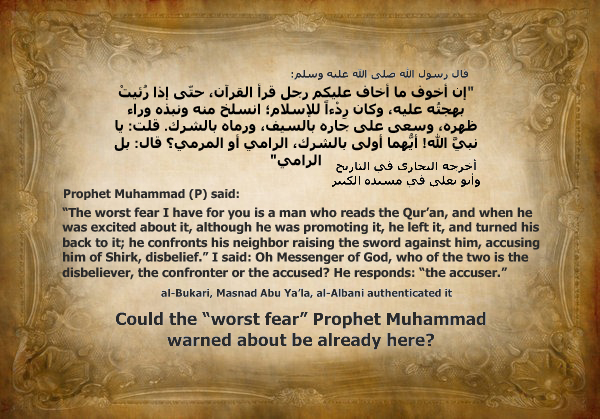
Finally, Dr. Abou El Fadl highlights the arrogance of the Puritan “Takfiri” mindset. While Moderates emphasize the Qur’anic discourse of God’s nearness and the privacy of individual faith, Puritans such as Muhammad ibn Abd al-Wahhab claim the authority to judge others’ hearts. By accusing fellow Muslims of “associating partners with God” (shirk), they justify the murder of those who do not adhere to their specific brand of austerity.
In doing so, the Puritan places God beyond emotion or love, transforming the “Mercy to the Worlds” into a cold instrument of vengeance.
The inception of the Wahhabi Creed
Rooted in the teachings of Ibn Taymiyya, Wahhabism was founded by Muhammad ibn Abd al-Wahhab (c. 1703–1791). Driven by a conviction to wage jihad against other forms of Islam, Abd al-Wahhab allied with tribal leader Muhammad ibn Saud to establish a state governed by his strict interpretation of Islamic Law, leading to a military campaign across the Arabian Peninsula. The Wahhabi doctrine labeled non-Wahhabi Muslims as infidels, providing justification for Ibn Saud to conquer neighboring settlements and spread Wahhabism through force. You can read the full overview posted by StevenAU.
Exporting Hatred
Exporting Hatred: The Global Proliferation of Wahhabism
Under the title “Exporting Hatred,”Ambassador Curtin Winsor, a former U.S. Special Envoy to the Middle East, provides a sobering report on the ideological epicenter of modern extremism:
Ambassador Winsor argues that while the physical infrastructure of groups like al-Qaeda may be targeted, their “ideological offspring” continue to proliferate globally. This contagion is difficult to combat because its financial and ideological heart resides in Saudi Arabia, where the royal family governs via a centuries-old pact with the Wahhabi sect.
The Saudi government has lavishly financed the global propagation of this extremist creed, often sweeping away moderate interpretations of Islam. Winsor reports:
• Financial Scale: Over the past two decades, the Saudis have spent at least $87 billion propagating Wahhabism abroad—a figure that has likely increased alongside rising oil prices.
• Institutional Capture: This funding supports the construction of mosques and madrassas, the training of Imams, and the domination of mass media and publishing. It even extends to university endowments, often used as leverage to influence the appointment of Islamic scholars.
The Literature of Exclusion
Ambassador Winsor further notes that literature bearing the “imprint of the Saudi Embassy” contains explicit mandates for social and religious isolation:
“Be dissociated from the infidels and hate them for their religion… Never greet the Christian or Jew first. Never congratulate the infidel on his holiday. Never befriend an infidel unless it is to convert him. Never imitate the infidel—do not even wear a graduation gown, as this mimics their ways.”
The Global Impact: Targeting the Vulnerable
The reach of Wahhabi proselytizing is not confined to the Muslim world; it has penetrated the social welfare states of Western Europe and the developing nations of South and Southeast Asia.
In countries like Pakistan, Indonesia, and the Philippines, well-funded Wahhabi missionary activities often overwhelm local, traditional religious institutions that lack a central hierarchy. Moderate Imams, who lack comparable financial patronage, find it nearly impossible to resist the influx of Saudi aid. Furthermore, children from impoverished backgrounds are frequently sent to Saudi Arabia for “education,” only to return as ideological “cannon fodder” for extremist fronts.
Part II The Consequences of Negation
Catastrophes, Bloodshed, and Violence
When hearts become spiritually dry and devoid of mercy, love, and compassion, and minds are consistently fed a diet of denial, hatred, and religious excess (Ghulu), the result is a catastrophic moral failure. This closed-off worldview fosters an “in-intellect” environment that gives zero consideration to alternative scholarly opinions and no weight to the consensus of mainstream Muslims. As a result, destruction, bloodshed, and violence become imminent.
Worse yet, through a calculated scheme of retiring critical thought—demanding their adherents listen and obey without question—the Salafi/Wahhabi clergies ensure their followers remain trapped in a dark, self-imposed zone of ignorance.
We see a clear picture of these teachings in the recent and continuous slaying of people and the widespread destruction across Iraq, Libya, Egypt, and Syria. These atrocities, carried out by followers of the Salafi/Wahhabi creed, present a stark contradiction to the Quranic mandate for human stewardship, making it seem as though corruption and destruction (fasad fil-ard) have become their primary function on Earth.
Salafi/The Consequences: Salafi/Wahhabi Carnage
Wherever the Salafi/Wahhabi environment takes root, the social climate is poisoned with a culture of negation, inducing bigotry, breeding hatred, and causing widespread violence. This violence manifests through organized groups such as al-Qaeda, al-Nusrah, and ISIS, as well as through individual actors like the Boston Marathon bombers, Syed Rizwan Farook of San Bernardino, and Ahmad Rahami in New York.
The relationship between Coptic Christians and Muslims in Egypt has been a subject of study and discussion. Analyzing this dynamic involves considering various social, historical, and political factors that have contributed to periods of both harmony and tension between the two communities.
Historically, Egypt has been home to both significant Coptic Christian and Muslim populations for centuries, with periods marked by coexistence and cultural exchange. However, as in many diverse societies, there have also been instances of friction and conflict, shaped by a range of internal and external factors.
Understanding the current state of Coptic-Muslim relations requires examining:
♦ Historical Context: The long history of both communities in Egypt and how their interactions have evolved over time.
♦ Socioeconomic Factors: The impact of economic conditions, social mobility, and resource distribution on inter-community relations.
♦ Political Dynamics: How political events, policies, and the actions of various groups influence the relationship between Copts and Muslims.
Understanding the current state of Religious and Cultural Influences: The role of religious interpretations, cultural practices, and the influence of different ideologies on community perceptions and interactions.
Examining these complex factors can provide a more nuanced understanding of the challenges and opportunities for fostering positive relations between Coptic Christians and Muslims in Egypt.
Here is a link to a little historical background from Global Politician on Wahhabi history and Egypt.
Wahhabism was confined mainly to the Arabian Peninsula until the 1960s, when the Saudi monarchy gave refuge to radical Muslim Brotherhood members fleeing persecution in Nasser’s Egypt. Cross-fertilization between the Wahhabi creed of the Saudi religious establishment and the Salafi jihadist teachings of Sayyid Qutb. Also, see the article “ISIS Formulation Orientation and Destination” for more details. The report continued to state:
Qutub denounced secular Arab rulers as unbelievers and proclaimed them legitimate targets of jihad. “It was the synthesis of the twain-Wahhabi social and cultural conservatism, and Qutbist political radicalism that produced the militant variety of Wahhabist political Islam that eventually produced al-Qaeda [and later ISIS].”
Sayyid Qutb: Echoing Abd al-Wahhab’s Rhetoric
The radical ideology of Sayyid Qutb, a leading figure within the Muslim Brotherhood, resonates deeply with the exclusionary oratory of Muhammad ibn Abd al-Wahhab. In his influential and controversial book, Milestones (Ma’alim fi al-Tariq), Qutb asserted that contemporary Muslim societies have reverted to a state of pre-Islamic ignorance (Jahiliyyah). He argued that true Muslims must perform hijra (migration) to an idealized “Islamic State” once founded, and those who refuse are considered apostates and infidels.
Qutb’s primary contention was that sovereignty (hakimiyyah) belongs exclusively to God. Consequently, any ruler or government that does not govern strictly by Sharia (Islamic Law) is considered a usurper of Divine authority, making their extermination a religious necessity (jihad).
Dr. Khaled Abou El Fadl, in his work The Great Theft: Wrestling Islam from the Extremists, notes the striking parallel between the two ideologues:
“Like ‘Abd al-Wahhab, Qutb accused the vast majority of Muslims of being hypocrites and heretics… Qutb’s willingness to declare Muslims apostates (takfir) was reminiscent of ‘Abd al-Wahhab’s rhetoric on true belief and apostasy.”
This convergence created the volatile synthesis of Wahhabi social conservatism and Qutbist political radicalism, a dynamic that ultimately provided the ideological blueprint for modern groups like al-Qaeda and ISIS.
The following sample of Qutb’s statements illustrates the profound extent of this dangerous misinterpretation of Islam from such a prominent, yet radical, Muslim Brotherhood leader.
Sayyed Qutb’s Arabic Statement:
Analyzing Qutb’s Ideology: Contradictions and Conflation
In his work Milestones (Ma’alim fi al-Tariq), Sayyid Qutb presents a complex and ultimately contradictory argument regarding Islamic governance and individual freedom. He states:
“It was not the intent of Islam to force people to embrace its belief since Islam is not just a belief. Islam, as we stated, is an order made to liberate man from being subservient to man. Therefore, Islam’s first goal is to oust all governing systems and regimes based on people ruling people… Then, all people shall be free to choose the religion they like, but only after they remove the political pressure… However, this experience should not mean that they are free to choose their whims as God or choose to be slaves or subservient [to other men] or take each other as lords, other than God. Any governing system on Earth must be based on ‘slavery to God only,’ and receive instructions from Him under such a governing system that people can freely choose their religions.” (Sayyid Qutb, Milestones, pg 71)
Qutb’s statement, while seemingly advocating for freedom of religion, is internally inconsistent and theologically problematic.
1. The Conflict with Freedom of Belief
Qutb’s inference that Islam’s primary goal is the forceful removal of all existing governments before individuals can exercise religious freedom directly conflicts with the explicit and undisputed Qur’anic injunction of freedom of belief: “There shall be no compulsion in [acceptance of] the religion” (Qur’an 2:256). His approach necessitates compulsion (via political revolution) as a precondition for freedom—a logical and theological paradox.
See, Qur’anic injunctions of freedom of belief.
2. Misplaced Priorities: Eradication vs. Invitation
By dangerously directing generations of young Muslims toward the “first priority of eradicating all governments,” Qutb fundamentally misrepresents the Prophetic mission. The primary Muslim mission is to embody the compassion and mercy of Islam, inviting people to God with wisdom, not repelling them with a threat of revolution. The Qur’an instructs believers:
“Invite to the way of your Lord with wisdom and good instruction, and argue with them in a way that is best. Indeed, your Lord is most knowing of who has strayed from His way and who is [rightly] guided.” — Qur’an 16:125
3. Usurping Divine Authority
Thirdly, Qutb appears to dictate a specific, narrow parameter for human existence, claiming that any human choice not aligned with his interpretation of “slavery to God only” is invalid. Allah created all people with free will and the capacity for moral choice. Qutb’s ideology, like that of Muhammad ibn Abd al-Wahhab, seeks to eliminate this divine gift of agency, imposing a rigid uniformity upon a world Allah created in diversity (lita’arafu).
The Muslim Brotherhood and the Delusion of the Islamic State (Khilafah)
The collapse of the Ottoman Caliphate in 1923 served as a catalyst for various Muslim thinkers seeking to recreate the Khilafah (Caliphate). Ideologues such as Abu al-Ala al-Mawdudi (d. 1979), influenced by Jamal al-Din al-Afghani (d. 1897), argued for a top-down approach: either establish a new Muslim state or reclaim existing ones through political revolution.
This contrasted sharply with figures like Muhammad Abduh, who represented the mainstream Ummah at the time. Abduh maintained that a genuine, sustainable system required a grassroots reformation to rebuild the Ummah’s faith and moral character first; the Khilafah would then be a natural reflection of that moral rebirth.
The Schism of Hassan al-Banna
According to Dr. Ali Gomaa, the former Grand Mufti of Egypt, Hassan al-Banna (d. 1966) founded the Muslim Brotherhood at age 22, an act that fundamentally split his party from the mainstream Ummah. His own teachers admonished him, stating:
“By creating a new Muslim party, you are splitting from the Ummah. You can be one of two: either be part of the Ummah or different than the Ummah.”
Al-Banna intentionally opted to be “different,” formalizing the Muslim Brotherhood with a politically ingrained, top-down approach inspired by al-Afghani and Mawdudi. As Dr. Khaled Abou El Fadl observes in The Great Theft: “It is not surprising that neither al-Afghani nor Mawdudi was a trained jurist”—meaning their political theories lacked deep grounding in classical Islamic law and ethics.
The “Upside-Down Pyramid” of Revolution
Hasan al-Banna and Sayyid Qutb, believing the Islamic state had ceased to exist, prioritized the immediate takeover of governments, bypassing the difficult responsibility of grassroots moral and faith-building. This approach mirrors the folly of attempting to build the pyramids of Egypt upside-down.
The results are evident in the Middle East’s current chaotic situation. Since the Muslim Brotherhood’s establishment in the 1950s, the region has endured a continuous cycle of violence, assassinations, bloodshed, and coups. In Syria alone, ten successful coups and 18 attempts occurred between 1958 and 1970, alongside three major armed revolution attempts by Muslim Brotherhood followers between 1963 and 1984.
The deviated teachings of Qutb and Muhammad ibn Abd al-Wahhab created a legacy of instability. As part of its clandestine structure, the Muslim Brotherhood established a secret military wing dedicated to organizing and executing coups, assassinations, and rebellions against local governments.
Armed Groups and the Destabilization of State Sovereignty
The sovereignty, stability, and security of any nation are fundamentally compromised when armed groups conspire against their governments from within or beyond their borders. The existence of non-state militant actors makes long-term progress nearly impossible.
In stark contrast, Muslim-majority nations such as Morocco, Malaysia, and Indonesia—which have largely resisted the penetration of the Salafi/Wahhabi and other politically motivated extremist ideologies—have achieved significant national development. These nations serve as examples of stable, developing economies, demonstrating that safety and stability are essential prerequisites for civilization.
This crucial understanding of the necessity of a unified state was not uncommon in early Islamic governance:
♦ Prophetic Precedent: The Prophet Muhammad ﷺ systematically dismantled internal militant factions in Medina and Khaybar precisely when the security and sovereignty of the nascent Ummah (nation-state) were threatened.
♦ Caliphal Governance: Similarly, the Second Caliph, Omar ibn al-Khattab, ordered the strategic relocation of populations (e.g., the people of Najran to Iraq) to ensure the internal stability and security of the expanding Islamic state.
The continuous tolerance of armed groups within a state infrastructure leads inevitably to fasad fil-ard (corruption and chaos on Earth), a condition that the Quran strictly forbids. See this Arabic video clip for reference.
Salafi/Wahhabi Extremists: Catalysts for the Syrian Crisis
The intolerance and hatred propagated by extremist ideologies do not cease at fostering antagonism between communities; they drive actual conflict. The Syrian crisis, which began as a civilian uprising, rapidly became a proxy war, a wagon conveniently mounted by nations like Saudi Arabia and Qatar through infiltration and support for various rebel factions.
External Support and Destabilization
Numerous sources document the engagement of external actors in the Syrian conflict:
♦ Reports indicate foreign backing for Syrian rebels from neighboring countries and the supply of arms [1, 2, 3].
♦ Documentation suggests that Saudi Arabia and Qatar established complex finance and arms supply networks, releasing jihadist prisoners from their jails to facilitate the devastation of Syria [4].
State-sponsored media outlets in the Gulf region have utilized satellite television and social media to propagate messaging against the Syrian government, simulating ammunition loaded with sentiments of hatred and jihadist slogans.
The Role of Clerical Authority
Dr. Yusuf al-Qaradawi, former head of the International Union of Muslim Scholars and a prominent figure in the Muslim Brotherhood, notably issued a religious verdict (fatwa) calling on all able Muslims to enter Syria and conduct Jihad to overthrow the Syrian government [5]. Al-Qaradawi, who resided in Doha, Qatar, had previously been expelled from his native Egypt due to his extreme political views and promotion of violence.
The Outcome: A Nation in Ruins
As a direct result of external interventions and the influx of extremist ideologies, the movement to “Improve Syria” devolved into a brutal war zone. The conflict, fueled by nations adhering to the Salafi/Wahhabi creed, resulted in the mass murder of Syrian citizens and the near-total obliteration of the nation’s infrastructure, resources, and institutions (health, education, industry, agriculture) [6].
[1] rt.com/news/rebels-jordan-syria-arab-833/ [2] www.democracynow.org/2013/3/15/2_years_after_invasion_to_crush [3] article.wn.com/view/2013/02/26/Saudi_Arabia_Arming_Syrian_Rebels_With_Croatian_Weapons_Sinc/ [4] The source is mentioned generally in the paragraph. [5] al-qaradawi.net/node/941 [6] en.wikipedia.org/wiki/Saudi_Arabian_support_to_Syrian_Opposition_in_the_Syrian_Civil_War
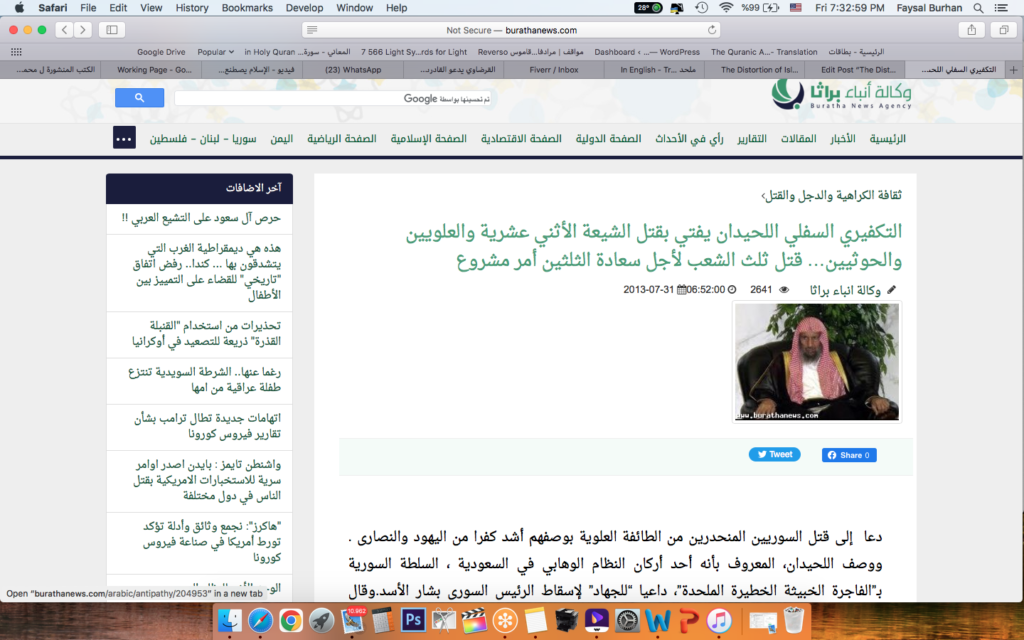
The following reports document the involvement of high-ranking Saudi clerics. Sheikh Saleh al-Luhaidan, then Head of the Supreme Judicial Council of Saudi Arabia, publicly urged Syrians to wage an internal jihadi war. He explicitly called for the killing of the Alawites (whom he referred to with the derogatory term “Nussayri”), labeling them “obscene, deceitful, dangerous, and atheists,” and linking them to the extinct Shia Fatimid Dynasty.
The Calculus of Carnage
Sheikh al-Luhaidan’s extreme ideology advocated for the slaughter of up to “one-third of the Syrian population” to accomplish his goal of overthrowing the Syrian government.
♦ The Scale of Hatred: In 2011, the Syrian population was approximately 21 million. Al-Luhaidan’s fatwa effectively translated to a call for the mass murder of up to seven million people.
♦ Ta’assub in Action: The reckless disregard for human life demonstrates how Salafi/Wahhabi ta’assub (fanaticism) prioritizes creedal purity over the sanctity of life, treating the destruction of an entire nation as a “weightless, worthless, and expendable” price to achieve a political objective.
Al-Luhaidan based his Alawite jihad call on the teachings of Ibn Taymiyyah, whom he quoted as saying that the Nussayri clans are “foremost in fighting against first, then others [infidels].”
A Return to the Ethics of Jahiliyyah
This rhetoric is an outrageous return to the ethnic prejudices of Jahiliyyah (pre-Islamic ignorance), which were explicitly banned by the Qur’an and the Sunnah of the Prophet Muhammad ﷺ. While the Prophet united diverse Arab tribes into a single nation, the teachings of al-Luhaidan and Ibn Taymiyyah actively promote sectarian division in direct opposition to Islamic principles.
1. The Principle of Proportionality and Defense
Islam permits fighting only in defense against active aggression. It does not permit the preemptive slaughter of people based on their sect or beliefs. This “unless they commit aggression” principle is fundamental to Islamic ethics of war and peace, as outlined in the article “The Basic Policy of Islam Regarding Non-Muslims: Peace or War?“.
Even during active hostilities, compassion is mandated:
“And if any of the idolaters seek your protection [O Muhammad], then protect him so he may hear Allah’s word and then convey him to his place of safety. That is because they are folk who know not.” — Qur’an 9:6
The verse explicitly commands safe passage, not execution, after the message is delivered.
2. The Prohibition of Sectarian Fighting
Islam strictly bans the kind of disparaging ethnic attitude found in the fatwa against the Alawites. The Prophet ﷺ warned against those who fight under a “blind banner” of fanaticism:
“One who fights under a blind banner (fighting because of heritage, whims, race, etc.), puffed up with ta’ssub, calls (people) to fight for their ta’s-sub—if he is killed (in this fight), he dies as one belonging to Jahiliyyah.” — Sunan Abi Dawood and Ibn Majah
Furthermore, those who attack the general populace are disavowed by the Prophet himself:
“Whoever indiscriminately attacks my Ummah, killing the righteous and the wicked of them, sparing not (even) those devoted to faith… he has nothing to do with me, and I have nothing to do with him.” — Sahih Muslim
3. The Mandate to Avoid Corruption on Earth (Fasad)
Islam bans terrorizing and corrupting peaceful communities. The actions urged by al-Luhaidan directly violate the Quranic command:
“And do not deprive people of their property, and do not commit mischief on the Earth, spreading corruption.” — Qur’an 26:183
“And do good as Allah has done well to you. And do not cause corruption and disorder in the land. Indeed, Allah dislikes corrupters.” — Qur’an 28:77
The resulting atrocities cannot, in any manner, be attributed to the merciful teachings of the Qur’an or Prophet Muhammad ﷺ. The Prophet emphasized the gravity of sectarian violence:
“Anyone who assists in shedding a Muslim’s blood, even as small as half a word, shall meet God written on his forehead ‘Hopeless from the mercy of God’.” — Ibn Majah
Recruiting Salafi/Wahhabi Jihadists to Fight in Syria
Through zealous efforts to achieve their goals of devastation, nations like Saudi Arabia and Qatar actively recruited several Salafi/Wahhabi jihadist organizations to operate in Syria. These organizations included the Islamic State of Iraq and Syria (ISIS) and the al-Nusra Front.
The al-Nusra Front, an al-Qaeda offshoot, was established on January 23, 2012, specifically to operate in the Syrian theater and maintain allegiance to Ayman al-Zawahiri, the successor to Osama bin Laden.
The Injustice of Slaughter
When confronted with the reckless brutality displayed by these groups—which includes the slaying of innocent people and the execution of prisoners of war or hostages—a fundamental question arises: In the name of what religion are these atrocities committed? Islam strictly forbids such acts.
Labeling an entire nation or a group of people—whether Sufi, Shia, Alawi, or Christian—and systematically killing them based purely on their identity is both heartless and criminal. Allah plainly describes those who practice such a hardened, exclusionary belief system in the following manner:
“Then your hearts hardened after that, like stones or even harder. For indeed, from some rocks, rivers burst forth, and some of them split open, and water comes out, and yet, some of them fall for fear of Allah. And Allah is not unaware of what you do.” — Qur’an 2:74 (Note: Corrected citation from 2:7)
“Then why did they not humble themselves when Our punishment came to them? But their hearts became hardened, and Satan made attractive to them that which they were doing.” — Qur’an 6:43
“Allah has set a veil over their hearts, their hearing, and their vision. And for them, there is a great punishment.” — Qur’an 2:7
(Note: Placed correct citation here)
These verses highlight a profound spiritual hardening that allows adherents to commit unspeakable violence under the delusion that their acts serve God, even as they cause immense human suffering.
Analyzing Conflict: Secular Armed Struggles vs. Creedal Crusades
Both general armed-civilian conflicts (jihadi wars in a secular sense) and the specific violence fueled by Salafi/Wahhabi religious rage are annihilators of peace and stability. However, the core motivations and potential outcomes of these conflicts differ significantly.
Motives and Objectives
♦ Secular Armed Conflict: These conflicts often arise from desires for material gain, power, or political autonomy. While devastating, such attacks may eventually end once the armed group achieves its objectives or inflicts sufficient damage.
♦ Salafi/Wahhabi Creedal Crusade: The objective here is ideological imposition—forcing the specific Salafi/Wahhabi belief system upon a target population. The “gain” is creedal homogeneity, and the perpetrators act as ideologically driven “butchers.”
The Scope of Destruction
There are no limits to the carnage in a Salafi/Wahhabi crusade until the target population adopts the specific creed. The violence is total and undertaken without guilt, as the perpetrators believe they are fulfilling a divine mandate. The devastating persecution seen recently in Iraq, Syria, and Libya illustrates this approach.
In these conflicts, nothing is spared:
♦ Marketplaces and funeral processions are bombed.
♦ Congregational prayers are attacked.
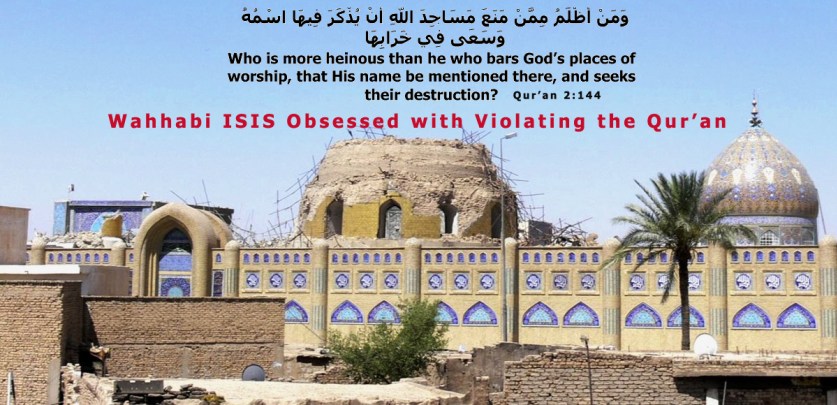
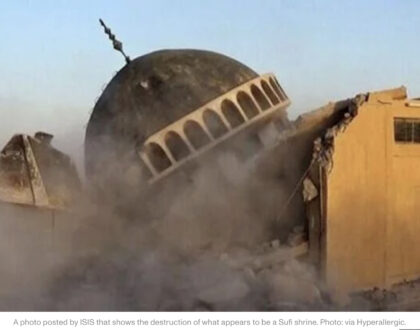
♦ Infrastructure, private property, and places of worship are deliberately destroyed.
Peaceful towns and entire countries are viewed as low-cost, expendable targets in the pursuit of ideological purity.
Due Process in Islam: The Sanctity of the Soul
Islam strictly mandates due process; no soul may be taken without lawful justification. This principle holds even for those who reject the faith, commit acts of aggression, or face the death penalty for capital crimes. The foundational Islamic rule regarding disbelief (kufr) requires two components: “The disbelieving person must reject Islam from deep within their heart first, and then declare it explicitly with their mouth.”
This standard raises a critical question for groups like the Salafi/Wahhabis: Where are the courts of law they established to validate this “rejection of Islam” and present proof of harm? Due process and formal validation were required for every single one of the thousands upon thousands they accused of infidelity and subsequently murdered.
Rejecting Conjecture: The Prophet’s Stand Against Presumption
Prophet Muhammad ﷺ profoundly disliked the killing of any soul based on mere conjecture or outward appearance. This is exemplified in the Hadith concerning Usamah ibn Zaid:
After a military expedition, Usamah reported killing a man who had declared the Shahadah (the declaration of faith). The Prophet ﷺ was deeply displeased and demanded an explanation: “Why did you kill a person witnessing the Shahadah?” Usamah claimed the man said it out of fear, not genuine faith. The Prophet ﷺ responded with a potent rebuke: “Did you open his heart to see whether or not he was a truthful believer? Who is to protect you from God if you kill a man who has said, ‘There is no god but Allah’?”
The explicit message of this Hadith is clear: you cannot judge the sincerity of a person’s heart. Allah reinforced this principle with a Revelation concerning the incident:
“O you who have believed, when you go forth [to fight] in the cause of Allah, investigate; and do not say to the one who gives you [a greeting of] peace, ‘You are not a believer,’ aspiring for the goods of worldly life, for with Allah are many acquisitions. You [yourselves] were like that before; then Allah conferred His favor upon you, so investigate. Indeed, Allah is ever, with what you do, Acquainted.” — Qur’an 4:94
This verse mandates careful investigation and prohibits the snap judgment of takfir (excommunication), fundamentally rejecting the arbitrary violence that defines extremist ideologies.
No Killing Based on Conjecture
The Sanctity of Intent: The Hadith of Usamah ibn Zaid
Prophet Muhammad ﷺ profoundly disliked the killing of any soul based on conjecture (zann). He rejected the idea that one could judge the sincerity of a person’s heart during a moment of crisis. This principle is powerfully illustrated in the famous account of Usamah ibn Zaid (may Allah be pleased with him):
“Allah’s Messenger (ﷺ) sent us [on an expedition] against a sub-tribe of Juhaina. We reached those people in the morning and defeated them. A man from the Ansar and I chased one of their men. When we attacked him, he said, ‘None has the right to be worshipped but Allah.’ The Ansari refrained from killing him, but I stabbed him with my spear until I killed him.”
“When we reached Medina, this news reached the Prophet (ﷺ). He said to me, ‘O Usama! You killed him after he had said, ‘None has the right to be worshipped but Allah. ‘ I said, ‘O Allah’s Messenger (ﷺ)! He only said so in order to save himself.’ The Prophet (ﷺ) said, ‘You killed him after he had said, ‘None has the right to be worshipped but Allah.’ The Prophet (ﷺ) kept on repeating that statement until I wished I had not been a Muslim before that day.” — (Sahih Bukhari)
The Profound Lesson
The Prophet’s intense reaction demonstrates a foundational principle of Islamic jurisprudence: outward actions and verbal declarations of faith must be accepted at face value. A believer is not granted the authority to “open hearts” and judge sincerity.
The Prophet’s persistent questioning deeply affected Usamah, leading him to regret his action so much that he “wished he had not been a Muslim before that day,” meaning he wished the sin of that action would be wiped clean by accepting Islam anew. This powerful narration underscores the gravity of takfir (excommunication/declaring someone an infidel) and the absolute necessity of due process and accepting apparent declarations of faith.
For this case, Allah (SWT) revealed:
O you who have believed, when you go forth [to fight] in
the cause of Allah, investigate; and do not say to the one who gives
you [a greeting of] peace. “You are not a believer,” aspiring
for the goods of worldly life, for with Allah are many acquisitions.
You [yourselves] were like that before; then Allah conferred His
favor upon you, so investigate. Indeed, Allah is ever with
what you do.Qur’an 4: 94
The Role of Bandar bin Sultan in the Syrian Crisis
Bandar bin Sultan, who previously served as Saudi Arabia’s Ambassador to the United States for 22 years, was appointed head of Saudi Intelligence in July 2012 and given direct responsibility for the Syrian file. Despite his extensive experience, his objective was to topple the Syrian government. In this endeavor, he reportedly invested all available resources, including alliances with al-Qaeda factions.
♦ Logistics of Conflict: Reports suggest Bandar bin Sultan may have facilitated the trafficking of over 12,000 Saudi nationals into Syria, alongside massive financing and weaponry supply networks. Many of those allegedly trafficked were hardcore Salafi/Wahhabi prisoners released from Saudi jails, who were anti-Saudi rule themselves.
♦ The Outcome: The work he spearheaded directly contributed to the devastation of Syria as a whole. His repeated failures in major political meetings eventually led King Abdullah to issue a “Royal Order” to “criminalize his operations and terminate his career,” according to Al-Akhbar.
By the end of 2014, the human cost of this jihadi proxy war was staggering: an estimated 150,000 lives lost, over a million citizens displaced, and thousands of businesses and homes destroyed. The economic infrastructure was systematically targeted and obliterated. See http://english.al-akhbar.com/node/19443
Creed vs. Compassion: A Question of Morality
Are these criminal acts committed to please Allah (SWT) or for the devil’s pleasure? Can the faith of mercy be transformed into a faith of terror and destruction? Yes, for those who systematically change the meanings of the Qur’an’s words and follow a distorted, extremist creed.
As highlighted in a report sourced from Free Republic regarding Wahhabi influence on the culture of war:
“The doctrines of Wahhabi Islam are playing another role in this war… for they are influencing the culture of war itself. Wahhabists are permitted by their doctrine to ‘rob, murder, and sexually violate’ (Jahili Lopez). Wahhabi extremists learn from a young age that all ‘nonbelievers’ are worthless and subject to persecution and death… This extremist view of ‘infidels’ has led the terrorists to use gruesome and hateful torture methods.”
This ideology returns to the roots of pre-Islamic ‘Asabiyyah (tribal fanaticism). Muhammad ibn Abd al-Wahhab and Ibn Saud exploited this ruthless Bedouin spirit for political expansion. By assuming the role of a hyper-elevated religious authority, al-Wahhab doubled the potency of this tribalism, creating strict rules for establishing his Dawlah (state) and launching his followers into a war against all who disagreed with his interpretation.
The ongoing destruction of nations and the profound atrocities inflicted upon Iraqi, Libyan, and Syrian souls are considered a nominal price for the expansion of this Salafi/Wahhabi creed. See Al-Wahhab Dawlah’s three rules.
Salafis Slay Muslim Spiritual Leaders in Russia
Examining acts of violence against religious leaders in Russia requires a careful approach, focusing on the events themselves and the condemnation of violence. These acts of violence against religious leaders are widely condemned and stand in stark contrast to core Islamic principles of peace and the sanctity of life.
Reports from 2010 and 2012 detail several attacks:
♦ In 2012, a suicide attack in Dagestan killed North Caucasus Mufti Sheikh Said Afandi and several others.
♦ Also in 2012, in Tatarstan, Mufti Ildus Faizov was injured in a car bombing, and clergyman Valiullah Yakupov was killed in a related shooting.
♦ In 2010, Sufi leader Sirajuddin Khuriksky was shot and killed outside his home in Dagestan.
These incidents highlight a concerning pattern of violence against religious figures who held influential positions within their communities.
Condemnation of such violence is rooted in fundamental Islamic teachings:
♦ Sanctity of Life: The Quran emphasizes the value of human life, stating that “if anyone kills a person, it would be as if he killed the whole people, and if anyone saves a life, it would be as if he saved the whole people” (Qur’an, 5:32).
♦ Justice and Due Process: Islamic jurisprudence requires a fair legal process for capital punishment, emphasizing the role of the court.
♦ Prohibition of Unjust Killing: Intentional killing of believers is strongly condemned in the Quran, with severe warnings of divine wrath and eternal punishment (Qur’an 4:93).
♦ Avoiding Generalizations: Judging individuals based on broad labels or group affiliations is contrary to the principle of individual accountability.
Focusing on the specific acts of violence and the widespread condemnation they receive, rather than making broad generalizations about entire religious groups, is crucial for understanding these tragic events while upholding principles of safety and respect.
Part III Where to Go from Here
Combating Extremism
What can one do to help stop the widespread defamation of Islam and the epidemic of violence? What is the solution to the Wahhabi radicalization, bloodshedding, and militancy problems?
To resolve the hate and violence crisis, one should start sincerely thinking with an open heart and clear mind to resolve these issues.
With no particular ideology in mind, each Muslim needs to learn about the peaceful life of Prophet Muhammad (PBUH) and how he peacefully interacted with people of all beliefs while avoiding bloodshed and wars. Therefore, read the Qur’an with a pure heart and a rational mind, remembering the times revealed to the Prophet of mercy (PBUH).
One must stop listening to hostile speeches loaded with disgust and bigotry—hardened hearts lacking empathy and feelings of pain and consciousness for fellow people. Heartless people, indeed, are shut off from the mercy of Allah (SWT); their ears hear not, and their eyes see not the truth.
And We have certainly created many of the jinn and humanity for Hell. They have
hearts with which they do not understand, eyes with which they do not see,
and ears with which they do not hear. Those are like livestock; instead, they
are more astray. It is they who are heedless.Qur’an 7:179
Slaying people based on twisted religious beliefs is a dangerous and radical epidemic; young people are quickly drawn into it. In search of answers as to where we go from here, the author invites Muslims and non-Muslims to contemplate the following subjects to understand the genuine and peaceful faith of Islam:
3- Watch and listen to the following scholarly, detailed, and eloquent video presentation by Dr. Adnan Ibrahim of Vienna disproving Ibn Taymiyah’s philosophy of the two versions of monotheism that permitted Wahhabis to declare war against whole Muslim nations who themselves believe in the Oneness of Allah. (Arabic). http://www.youtube.com/watch?v=qAgO0RyIBd4&feature=plcp
4- Is Islam peace and mercy or horror and terror? Allah (SWT) commands:
O you who have believed, enter into Islam [peace] ultimately [and ideally], and
do not follow the footsteps of Satan. Indeed, he is to you a clear enemy. Qur’an 2:208
Murder is Strictly Impermissible in the Qur’an
And don’t kill a soul that God has created inviolable; save lawfully. (i.e., for a criminal offense) Qur’an 6:151
… whoso kills a soul unless it’s for murder or for wreaking corruption in the land,
it shall be as if he had killed all humankind; and he who saves a life, it shall be as if he had
given life to any or all human beings.Qur’an 5:53
The Prophetic Model: An Ethic of Mercy and Forgiveness
The life of Prophet Muhammad ﷺ provides the ultimate blueprint for engaging with others through education, discipline, and compassion, rather than the termination of lives. His mission focused on changing hearts and minds to ensure spiritual success, prioritizing forgiveness over retaliation. As the late Dr. Hassan Hathout wisely observed: “We, doctors, treat patients by treating their illnesses, not by killing them.”
Here are key examples of the Prophet’s ethics of mercy:
♦ Forgiveness of Ta’if: Though treated brutally—injured and driven from their town with a broken heart—the Prophet ﷺ forgave the people of Ta’if when offered a chance for retribution.
♦ Kindness in the Mosque: When a Bedouin urinated in the mosque, the Prophet ﷺ responded with kindness and patience, explaining the sanctity of the place rather than punishing the man.
♦ The Power of Peace: Karen Armstrong notes in her biography that the Prophet was a strategic peacemaker:
“Far from being the Jihad father, Muhammad was a peacemaker who risked his life and nearly lost his closest companions because he was determined to reconcile Mecca. Instead of fighting an intransigent war to the death, Muhammad was prepared to negotiate and compromise. And this apparent humiliation and capitulation proved, in the words of the Qur’an, to be a great victory [fat-‘h]…”
♦ The Amnesty of Mecca: After nearly 20 years of hardship and persecution, the Prophet ﷺ returned to his birthplace, Mecca, without retaliation or bloodshed. He addressed the defeated populace with his famous words: “Go about (wherever you please), for you are set free.” This act reflects Islam’s core values—mercy and forgiveness, a profound rejection of arrogance and bloodshed.
♦ Personal Forgiveness: The Prophet ﷺ forgave Hind, who had plotted the murder of his uncle Hamza and chewed his liver. He also forgave those who had spread false rumors against the honor of his wife, Aisha.
The Inviolable Sanctity of the Human Soul
Muslims must be educated about the core dangers of extremist creeds and the brutal slaying of human souls. The ultimate end of a philosophy based on hatred is self-destruction. The foundation of creation is al-Huqq (the rightful truth), and Allah warns those who violate this truth:
“Have you not seen Allah create the heavens and the Earth in ‘al-Huqq’ [rightful truth]? If He wills, He can do away with you and produce a new creation.” — Qur’an 14:19
Allah has fundamentally sanctioned the human soul, declaring its protection paramount:
♦ “And do not kill the soul Allah has forbidden [to be killed] except by [legal] right.” — Qur’an 6:151
♦ “But whoever kills a believer intentionally—his recompense is Hell, wherein he will abide eternally, and Allah has become angry with him and has cursed him and has prepared for him a great punishment.” — Qur’an 4:93
♦ “If anyone kills a person, it would be as if he killed the whole people, and if anyone saves a life, it would be as if he saved the entire people.” — Qur’an 5:32
Even during conflict, the inclination toward peace is mandated:
“And if they are inclined to peace, then you are inclined to it [also] and rely upon Allah. Indeed, it is He who is the Hearing, the Knowing.” — Qur’an 8:61
The path of the believer is defined by returning evil with good, fostering peace rather than perpetual enmity:
“Repel [evil] by that [act] which is better; and thereupon, the one whom between you and him is enmity [will become] as though he was a devoted friend.” — Qur’an 41:34
Conclusion: A Call for Reform and the Reclamation of Mercy
There is a need to return to the core values of Islam: mercy and peace.
The Path of the Believer
Muslims of all creeds and generations must re-evaluate the foundations of their faith. We must cease following teachers or fatwas that espouse hatred and weigh all issues with clear, unbiased minds, free from the tribalism of ’asabiyyah. True believers must stand firm against these satanic acts that bring the highest degree of defamation upon Islam.
The standard of al-Huqq (the rightful truth) governs the heavens and the Earth. When humanity faithfully chooses to transgress the boundaries of righteousness, consequences inevitably follow. The destiny of those who violate the fair laws of creation is to succumb to the very chaos they create:
“Have you not seen that Allah created the heavens and Earth in truth (al-Huqq)? If He wills, He can do away with you [because of your transgressions] and produce a new creation.” — Qur’an 14:19
True faith demands adherence to justice, mercy, and peace for all.